
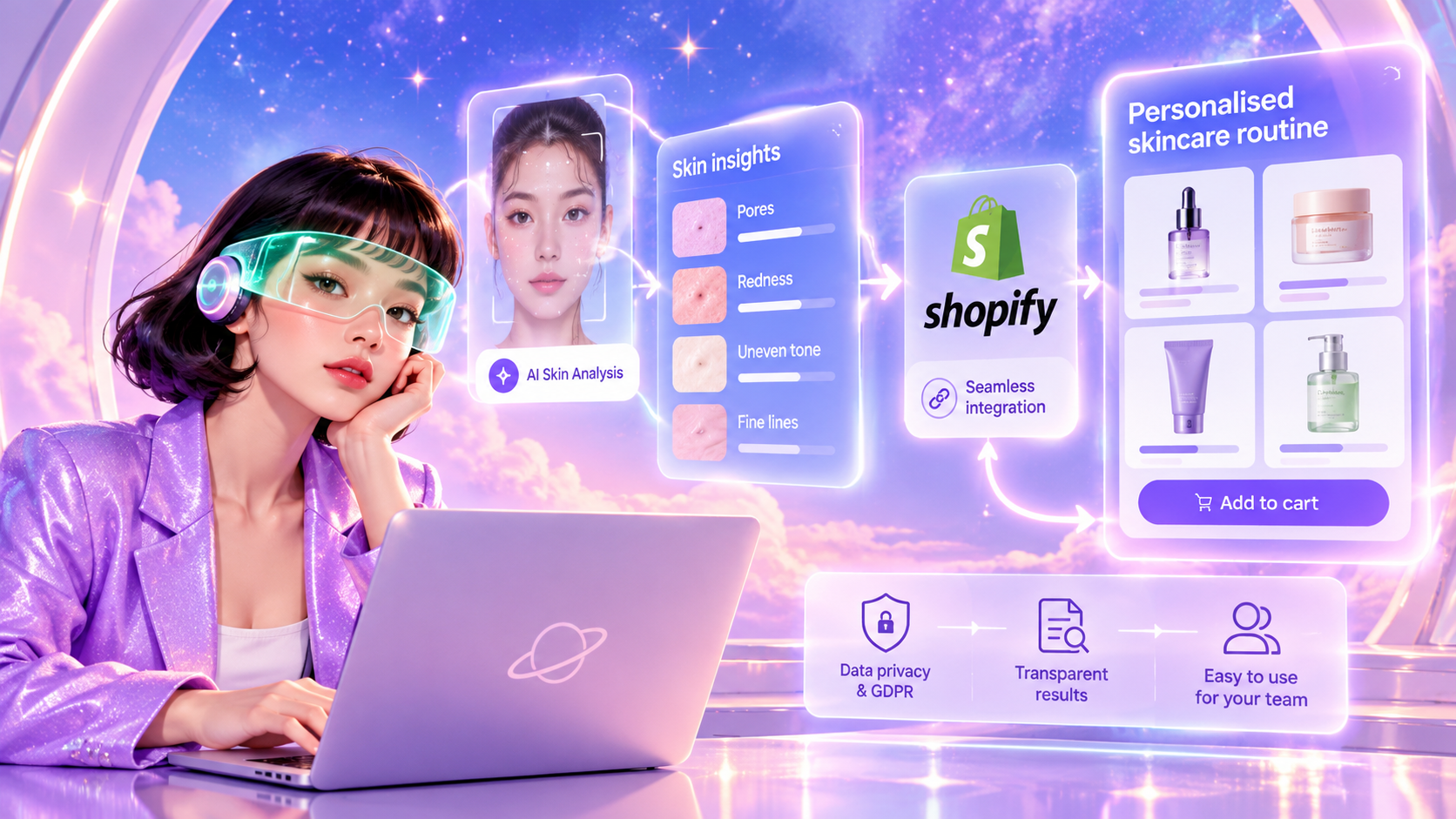
AI skin analysis personalizes a Shopify store by turning a shopper's selfie into a skin profile and matching it with products from the store's own catalog, using their INCI ingredient lists. Instead of browsing generic categories, the shopper receives a skincare routine chosen by the AI around the visible characteristics of their skin.
For beauty e-commerce managers and skincare retailers, the question is no longer whether personalization matters, but how to add it without developers, without confusing shoppers and without losing control of customer data.
This guide explains how an AI skin analysis platform integrates with Shopify, WooCommerce and WordPress, how it generates personalized skincare product recommendations, and what to check about privacy, transparency and ease of use.
1. What Is AI Skin Analysis for E-Commerce?
AI skin analysis for e-commerce is a technology that evaluates visible skin characteristics from a selfie and uses the results to recommend suitable cosmetic products available in an online store.
It brings to an online store part of the guidance a beauty advisor gives in a shop: understanding what a shopper's skin needs and pointing to the right products. Two concepts explain how it works:
Computer vision
The branch of artificial intelligence that lets software analyze images. In skin analysis, it detects visible characteristics such as blemishes, redness, pores, wrinkles or uneven tone in a selfie.
INCI
International Nomenclature of Cosmetic Ingredients: the standardized names used on cosmetic ingredient lists. Ingredient names and functions can be checked in the European Commission's CosIng cosmetic ingredient database.
Dermaself combines both: its AI skin analysis technology, built on 30 years of clinical research, reads visible skin characteristics, while ingredient intelligence connects them to the INCI lists of the products a store sells.
2. How Does AI Skin Analysis Personalize a Shopify Store?
AI skin analysis personalizes a Shopify store in three steps: it reads the shopper's skin from a selfie, matches the results with the INCI ingredients of the store's products, then shows a personalized routine.
With Dermaself, the experience runs inside the store, the AI makes the analysis and the recommendations, and every recommended product comes from the merchant's own catalog:
1. Selfie skin analysis
The shopper takes a selfie on the store. Dermaself analyzes visible skin characteristics and returns a skin report in seconds.
2. Ingredient matching
Dermaself's AI compares the detected skin characteristics with the INCI ingredient lists of the store's products to find the most suitable ones.
3. A routine from your catalog
The AI selects the products and shows them as a routine, each with a short “why we picked it” note.
The AI makes the analysis and chooses the products. Brands can add a few optional questions for user research, to learn more about their shoppers, but the answers do not change the skin analysis or the recommended products. AI skin analysis is also a cosmetic assessment, not a medical diagnosis, and does not replace a dermatologist.
3. How Do You Add AI Skin Analysis to Shopify, WooCommerce or WordPress?
On Shopify and WooCommerce, AI skin analysis can be added with an app or plugin in three steps: install, connect the catalog, then brand the skin test and publish it. No developer or code is required.
WooCommerce is the e-commerce plugin for WordPress, so WordPress stores selling online use the same WooCommerce plugin. The features are the same on Shopify and WooCommerce; only the installation changes:
Platform
How to install
What you get
Shopify
How to install
Install Dermaself: AI Skin Analysis from the Shopify App Store
What you get
All features, managed from the Shopify admin
WooCommerce (WordPress)
How to install
Install the Dermaself Skin Advisor plugin from the WordPress plugin directory
What you get
The same features as on Shopify, managed from the WordPress admin
Other platforms
How to install
Widget or API, including custom and headless stores
What you get
The same AI, with a custom Enterprise setup and a dedicated account manager
Once the app is installed, products sync automatically and Dermaself reads their INCI ingredients. The full steps are on the AI skin analysis for e-commerce page.
4. What Can Beauty E-Commerce Teams Customize?
E-commerce teams can adapt the skin analysis experience to their brand and their marketing tools, directly from the store admin, while the AI keeps choosing the products. The features below are the same in the Dermaself apps for Shopify and WooCommerce:
Branding
Colors, logo and copy matched to the brand, so the skin test looks like part of the store.
Questions for shopper insights
Brands can add their own questions to learn about their shoppers; a full quiz builder is included in the paid plans. Answers do not change the AI recommendations.
AI recommendations from your catalog
Dermaself's AI chooses the products, only from the store's catalog, and explains each choice to the shopper.
Klaviyo and Mailchimp
Email marketing platforms: skin profiles can be sent to email lists to follow up with relevant products.
Analytics
Completion rate, purchases from recommendations and shoppers' top skin concerns.
Made for mobile
Designed to be fast and light on any device, with minimal impact on page speed.
5. What Results Can Personalized Skincare Recommendations Deliver?
Personalized recommendations help shoppers buy a complete routine instead of a single product, which shows up in conversion rate, average order value and products per order.
Dermaself e-commerce results
Average results reported by Dermaself across its e-commerce partners, comparing shoppers who take the skin analysis.
+17%
conversion rate, from 2.4% to 2.8%
+20%
average order value, from €45 to €54
+15%
products per order
Source: Dermaself, average across 12+ e-commerce partners over 12 months. Averages, not guaranteed results: outcomes depend on the store, its catalog and its traffic.
What does this look like on a real Shopify store?
Italian skincare brand DF18+ added Dermaself to its Shopify store in 5 days, mapping a 40-product catalog: 40.8% of shoppers who start the skin test complete it, and each routine recommends 3–5 products. Read the DF18+ Shopify case study.
Skincare brand Heedra used the same experience at a pop-up event in Milan, then brought it to its Shopify store, with a 5-day setup for 25 products. See the Heedra case study and the full numbers on the impact on revenues page.
6. How Should Shopify Stores Handle Privacy and Transparency?
A skin analysis app should make clear to shoppers why a selfie is requested, which data are used and what the analysis can and cannot do. Clear explanations build trust and help shoppers decide whether to take the test.
To build recommendations and measure results, the Dermaself app uses the store's products and collections, orders from the last 60 days, discounts and theme data, and shoppers' device and activity data. Details are in the Dermaself Privacy Policy.
What should merchants check before going live?
Before adding selfie-based analysis to a store, e-commerce teams should be able to answer:
Which images and personal data are collected?
For which purposes are they processed?
Are selfies stored, and for how long?
Who can access the information?
How are shoppers informed before the test?
Which responsibilities belong to the store and to the provider?
Using AI does not by itself make a store compliant with data protection rules. In the EU, the General Data Protection Regulation (GDPR) applies to how personal data are processed; each store should review the provider's documentation and its own setup.
Why does transparency matter for skincare recommendations?
Shoppers trust recommendations they understand. Showing a short “why we picked it” note for every product, and stating that the analysis is cosmetic and not medical, keeps expectations realistic. For a deeper look at facial image privacy, read the guide to AI skin analysis accuracy, privacy and GDPR.
7. How Much Does AI Skin Analysis for Shopify Cost?
Dermaself can be started for free on Shopify and WooCommerce, with 25 skin analyses a month, and upgraded when a store needs more. One analysis is one skin test completed by a shopper.
Plan
What is included
Price
Free
What is included
25 skin analyses a month, up to 100 products, standard analytics
Price
$0, no time limit
Start
What is included
60 skin analyses a month, up to 100 products, quiz builder and advanced analytics
Price
$49/month or $490/year
Growth
What is included
200 skin analyses a month, up to 200 products, quiz builder and advanced analytics
Price
$129/month or $1,290/year
Enterprise
What is included
More than 200 analyses a month, any platform via widget or API, dedicated account manager
Price
Custom quote
Prices are in USD and billed through the store. Plans and conditions are on the Dermaself pricing page.
8. Getting Started With AI Skin Analysis on Your Store
The fastest way to evaluate AI skin analysis is to try it on your own catalog.
On Shopify or WooCommerce, install the app, sync your products and take a selfie on your store to see the routine Dermaself builds from what you sell.
For custom or headless stores, several stores, in-store screens or more than 200 analyses a month, Dermaself designs a custom setup with your team.
The goal stays the same: connect each shopper's skin needs with the right products, in a way that is easy to use and easy to understand.

Frequently Asked Questions
AI skin analysis on Shopify and WooCommerce: quick answers for e-commerce teams
Does AI skin analysis also work on WooCommerce and WordPress stores?

Yes. Dermaself is available as an app for Shopify and as a plugin for WooCommerce, the e-commerce plugin for WordPress, installed from the WordPress plugin directory. Both connect the store's catalog to the skin analysis without code. Custom or headless stores can use Dermaself through a widget or API with an Enterprise plan.
Is an AI skin analysis a cosmetic diagnosis?
No. AI skin analysis is a cosmetic assessment of visible skin characteristics, such as blemishes, redness or pores, used to recommend cosmetic products. It is not a medical or dermatological diagnosis and does not replace a dermatologist. Stores should say this clearly to shoppers before the skin test.
Why are INCI ingredients used to match products to a shopper's skin?
INCI ingredient lists describe what each product contains, so they are a consistent basis for comparing products with skin needs. Dermaself's AI compares the skin characteristics detected in the selfie with the INCI lists of the store's products, then explains each recommendation with a short note.
How long does it take to add AI skin analysis to a Shopify store?
Installing the Dermaself app and syncing the catalog can be done from the Shopify admin, without a developer, and the first analysis can run in minutes. Brands that chose a guided setup, such as DF18+ with 40 products and Heedra with 25, went live in 5 days.
Will a skin analysis widget slow down product pages?
The Dermaself skin test is designed to be fast and light on any device, with minimal impact on page speed, and the analysis itself returns results in seconds. As with any app, stores should check page speed on their own theme after installing it.
What should shoppers be told before they take a selfie?
Shoppers should know why the selfie is requested, which data are used to build recommendations and where to read the privacy policy. It also helps to state that the analysis is cosmetic, not medical, and that every recommended product comes from the store's own catalog.