
In Dermaself, INCI analysis is built into the AI skin analysis, not a separate software. The same AI that reads a customer’s skin from a selfie also reads the INCI ingredient list of every product in the brand’s catalog, and recommends the products whose ingredients address the skin concerns it has detected. Many AI skin analysis platforms link skin results to products through marketing claims such as “anti-aging” or “hydrating”: Dermaself links them through what is actually in the formula. Dermaself calls this feature Ingredient Intelligence.
For beauty e-commerce managers and skincare brands, this means skin analysis and cosmetic ingredients are evaluated together, and every recommendation can be explained by two facts: the customer’s skin concerns and the ingredients in the formula.
This article explains what INCI-based skincare software is, how INCI analysis works inside Dermaself’s AI, how ingredient-based recommendations differ from claim-based ones and what to evaluate when comparing skincare platforms. For a broader overview, read what to know about AI skin analysis platforms.
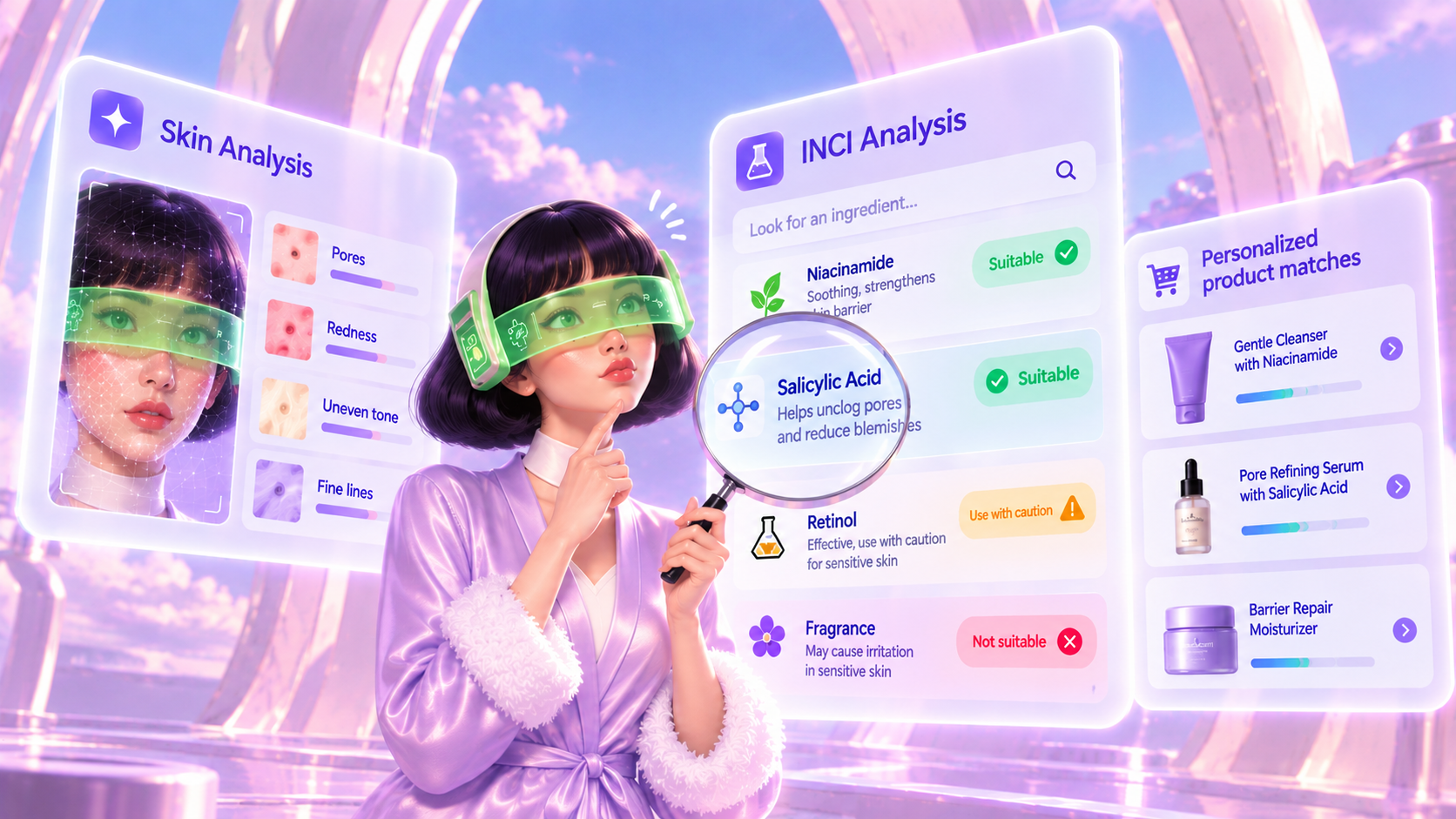
1. What Is INCI-Based Skin Analysis Software?
INCI-based skin analysis software is an AI skin analysis platform in which the same AI reads the customer’s skin and the ingredient list (INCI) of every product, then recommends the products whose ingredients address the skin concerns it has detected, instead of relying on what the product claims. It is also called INCI-based skincare software. In the most complete platforms, ingredient analysis is not a separate program added on top of the skin analysis: it is part of the same AI.
Two terms are at the core of this approach:
INCI
The International Nomenclature of Cosmetic Ingredients: the official ingredient list printed on every cosmetic. In the EU it is required by the Cosmetics Regulation (EC) No 1223/2009.
Ingredient-based matching
The process that links each skin concern, such as redness or dryness, to the ingredients that address it, and then to the products that contain them. In Dermaself it is built into the AI and is called Ingredient Intelligence.
Because the INCI list uses the same names on every product and, in the EU, lists ingredients in descending order of concentration (for those above 1%), it gives software a standard, objective basis to compare formulas across a whole catalog.
2. Which Key Factors Should You Evaluate in an Ingredient-Based AI Skin Analysis Platform?
A strong INCI-based skincare platform reads the skin and the ingredients with the same AI, and can be evaluated on six factors: skin analysis, ingredient data, skin–ingredient matching, ingredient compatibility, catalog-based recommendations and explainability. The factor that separates platforms most is the third one: whether products are matched through their ingredients or through marketing claims.
1. Skin analysis quality
Which visible skin concerns the AI reads from a selfie, and on which dermatological research its criteria are based.
2. Ingredient data source
Where ingredient information comes from. An official source such as the European Commission’s CosIng database ensures consistent, verified data.
3. Skin–ingredient matching
Whether cosmetic product matching links each skin concern to products through their ingredients (INCI) or only through marketing claims and manual tags. Ingredient-based matching is objective and comparable across brands.
4. Ingredient compatibility
Whether the platform checks that products recommended together have ingredients that work well together.
5. Recommendations from your catalog
Recommendations should come only from the products your store sells, selected by the AI based on skin and ingredients.
6. Explainability
Every recommended product should come with a clear reason, so shoppers understand why it suits their skin.
Why it matters for e-commerce: explained recommendations help shoppers find their way through a large catalog and discover a complete routine instead of a single product.
3. How Does INCI Analysis Work Inside Dermaself’s AI?
INCI analysis is built into Dermaself’s AI: in the same analysis, the AI reads the skin from a selfie and the INCI list of every product in the catalog, then recommends the products whose ingredients address the skin concerns it has detected. It is not a separate tool to install or configure: it is the way Dermaself’s AI chooses products. Dermaself calls this feature Ingredient Intelligence.
Dermaself Ingredient Intelligence
One AI, two analyses: the skin and the formula.
60+
visible skin parameters analyzed from a selfie
30 years
of Derming dermatological research behind the analysis criteria
220,000+
annotated skin lesions used to train Dermaself’s AI
Source: Dermaself and Derming. Ingredient data from the European Commission’s CosIng database.
From selfie to personalized routine: the four steps of Dermaself’s AI
1. Skin analysis
The AI reads visible skin concerns from a selfie, such as pimples, dryness, wrinkles, dark spots, redness, skin laxity, enlarged pores and dark circles.
2. INCI analysis
The same AI reads the INCI list of every product in the catalog, normalizes it with CosIng data and classifies each product by what its ingredients do, with no manual tagging.
3. Skin–ingredient matching
Each skin characteristic is linked to the ingredients that address it, following criteria from dermatological research.
4. Personalized routine
The AI builds morning, evening and weekly routines, with a main product and alternatives for each step, a fit percentage and a “why we picked it” note.
Ingredients, not marketing claims: a product labeled “anti-aging” is recommended for wrinkles only if its INCI list contains ingredients that address wrinkles. Each ingredient is also evaluated for compatibility with the skin and compliance with the EU Cosmetics Regulation.
Ingredient-based vs claim-based skincare recommendations
Claim-based recommendations link skin results to products through what each product says about itself: marketing claims such as “anti-aging”, “hydrating” or “for sensitive skin”, or tags added manually by the brand. Two products with the same claim can contain very different formulas, and the platform cannot explain why a product suits a specific skin.
Ingredient-based recommendations, the approach used by Dermaself’s AI, link skin results to products through what each formula contains. The AI reads the INCI list, identifies the ingredients that address each skin concern detected in the selfie and recommends the products that contain them, each with a “why we picked it” note.
Discover the science behind it on the Dermaself technology page, and check ingredient definitions in the European Commission’s CosIng database.
4. Why Does Ingredient Compatibility Matter in Skincare Recommendations?
Ingredient compatibility makes sure that the products recommended together in a routine work well together. A personalized routine is more than a list of good products: each step has to fit with the others.
Dermaself applies compatibility rules to every routine it builds, checking that the products chosen for the same routine have ingredients that work well together. The result is a balanced routine that shoppers can follow with confidence, and complete bundles that increase cross-selling for the brand.
The AI chooses, the catalog sets the range. Dermaself recommends only products the brand sells, and the AI selects them based on the customer’s skin and on each product’s ingredients.
5. How Does Dermaself Integrate with Your E-commerce?
Dermaself connects to your store without code: the catalog syncs automatically and the AI reads the INCI list of every product, with no manual tagging.
It is available as an app for Shopify and as a plugin for WooCommerce on WordPress, with the same features on both platforms. The brand maps its products to the routine steps, such as cleanser, serum, moisturizer, SPF and night cream, and each store’s catalog stays separate from every other. It connects with Klaviyo and Mailchimp, the widget is available in English, Italian, Spanish and French, and the same analysis runs in physical stores. Brands can start with 25 free analyses a month on their real catalog.
See how AI skin analysis personalizes Shopify and WooCommerce stores and the Dermaself solution for e-commerce.
Case study · DF18+
DF18+, an Italian skincare brand with 40 SKUs for mature skin, added Dermaself to its Shopify store in 5 days. Shoppers receive routines of 3 to 5 products from the DF18+ catalog, matched through INCI analysis and explained one by one, and 40.8% of shoppers who start the skin test complete the full analysis.
“Dermaself transformed our online store from a product catalog into a personalized skincare advisor.” — Sibilla Milani, Founder & CEO, DF18+
Read the full DF18+ case study.
6. Checklist: Questions to Ask Before Choosing an AI Skin Analysis Platform with INCI Analysis
Use these questions to compare skincare platforms that combine skin analysis and cosmetic ingredient analysis.
Question to ask
Dermaself
Question
Does it analyze the skin from a selfie?
Dermaself
Yes, more than 60 visible skin parameters.
Question
Does it read the INCI list of every product?
Dermaself
Yes. INCI analysis is built into the AI and uses ingredient data from the European Commission’s CosIng database.
Question
Are products matched by ingredients or by marketing claims?
Dermaself
By ingredients: each skin concern is linked to the ingredients that address it, following criteria from dermatological research.
Question
Does it check ingredient compatibility within a routine?
Dermaself
Yes, with compatibility rules applied to every routine.
Question
Are recommendations explained to shoppers?
Dermaself
Yes, every product comes with a “why we picked it” note.
Question
Does it integrate with your store?
Dermaself
Yes, Shopify and WooCommerce with no code, plus in-store use.
Dermaself: AI Skin Analysis with Built-In INCI Analysis
Dermaself is an AI skin analysis platform with INCI analysis built into its AI, a feature called Ingredient Intelligence: the same analysis reads the customer’s skin and the INCI list of every product, so recommendations are based on ingredients rather than marketing claims. Shoppers receive personalized skincare routines selected from the brand’s catalog, each with a clear reason, online and in store.
Discover the Dermaself solution for beauty e-commerce and the technology behind it.

Frequently Asked Questions
INCI-based skincare software: quick answers for beauty e-commerce teams and skincare brands
What is INCI-based skin analysis software?

INCI-based skin analysis software is an AI skin analysis platform that reads a person’s skin from a selfie and the INCI ingredient list of every product in a catalog, then recommends the products whose ingredients address that person’s skin concerns. In Dermaself, INCI analysis is a feature built into the AI, called Ingredient Intelligence, not a separate tool.
Why is the INCI list useful for personalized skincare recommendations?
The INCI list is useful because it names every cosmetic ingredient with the same international standard, so software can compare formulas objectively across an entire catalog and connect each ingredient to the skin needs it addresses, instead of relying on marketing claims. In the EU, ingredients above 1% are listed in descending order of concentration.
Where does Dermaself get its ingredient data?
Dermaself uses ingredient data from the European Commission’s CosIng database, the official EU database of cosmetic ingredients, to normalize the INCI list of every product in a brand’s catalog. Each ingredient is then evaluated for effectiveness, compatibility with the skin and compliance with the EU Cosmetics Regulation.
How does Dermaself’s AI use the INCI list to recommend products?
Dermaself’s AI reads the INCI list of every product in a brand’s catalog, links each skin concern detected in the selfie to the ingredients that address it, following criteria from dermatological research, and recommends the products that contain them, each with a fit percentage and a “why we picked it” note. Dermaself calls this built-in feature Ingredient Intelligence.
Does Dermaself check that recommended products work well together?
Yes. Dermaself applies compatibility rules to every routine it builds, checking that the products chosen for the same routine have ingredients that work well together, so morning, evening and weekly routines stay balanced and easy for shoppers to follow.
How quickly can a skincare brand add INCI-based recommendations to its store?
A skincare brand can add Dermaself’s INCI-based recommendations to its store quickly and without code, because the Shopify app and the WooCommerce plugin sync the catalog automatically. Italian skincare brand DF18+ went from kickoff to a live widget on Shopify in 5 days, with 40 SKUs mapped.